

.png)

Insights, Fast: Why Analytics Needs an AI Analyst (and Where We’re Headed)
Welcome to our new monthly blog series on real analytics insights: the breakthroughs, the real-life wins, and what’s coming next.
As a Product Analytics Lead at HawkSearch, Parinay Rikhy helps organizations turn complex data into business decisions. This monthly series explores emerging trends, real customer learnings, and the evolving role of AI in analytics and ecommerce optimization.
Over the years, I’ve worked with eCommerce teams trying to solve the same challenge: not what happened, but why. Dashboards make it easy to track key performance indicators, but the most important business questions often come after the report is opened.
In this monthly Analytics Insights series, I’ll share observations from the field, lessons learned from search and recommendation analytics, and perspectives on how AI is changing the way teams find and act on insights to improve their bottom line.
Why Traditional Analytics Dashboards Can’t Answer Every Question
Dashboards are designed to answer the questions we expect.
They provide a reliable view of recurring metrics and help teams monitor the health of their eCommerce experience. Revenue, search traffic, engagement, conversion rates, and recommendation performance all deserve a trusted place for ongoing reporting.
But business questions rarely stop with a KPI.
Every demo follows a similar pattern. The dashboard makes sense, and then someone asks a follow-up question.
- Which searches lost clicks last month?
- What changed after a catalog update?
- Which products receive traffic but never convert?
- Why is recommendation revenue growing in one category but declining in another?
A dashboard may reveal that more than 70% of keyword clicks occur within the top three results. What it often doesn't reveal is which high-volume searches are underperforming, where customers are dropping off, or where revenue opportunities may be hidden.
The challenge isn't a lack of data. It's the ability to quickly explore the next question.
What Is an AI Analytics Assistant
An AI analytics assistant enables business users to ask questions about their data using natural language and receive answers without needing SQL, custom reports, or deep knowledge of underlying datasets.
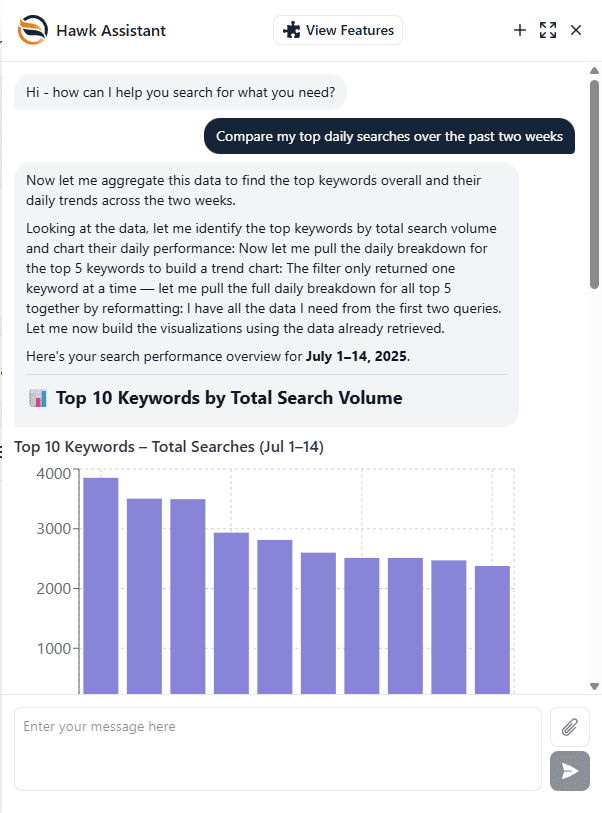
Instead of navigating dashboards and filters, users can simply ask:
- Which searches lost clicks over the last 30 days?
- Which products receive traffic but aren't converting?
- Which recommendation widgets drive the most revenue?
- Which product categories are showing rising demand?
The goal isn't to replace dashboards or analysts. It's to reduce the time between a business question and a trustworthy answer.
A Real Example: Finding Revenue Beyond the Dashboard
In one analysis, a customer reviewed more than 365,000 searches to better understand shopper behavior and search performance.
The top-level metrics looked healthy, but the deeper analysis uncovered nearly $500,000 in revenue opportunities. Certain keyword searches drove significantly higher engagement, some high-volume searches were underperforming, and important patterns were hidden beneath the dashboard's summary metrics.
The discovery didn't come from creating another report. It came from asking follow-up questions.
That's the challenge facing many analytics teams today. Business questions move quickly, but getting answers often requires digging through reports, exporting data, or waiting for analyst support.
How the HawkSearch Analytics Assistant Turns Questions Into Answers
This is the challenge that inspired the HawkAgent Analytics Assistant.
Rather than starting with the question, "Which report contains this information?" Teams can start with the actual business problem they are trying to solve.
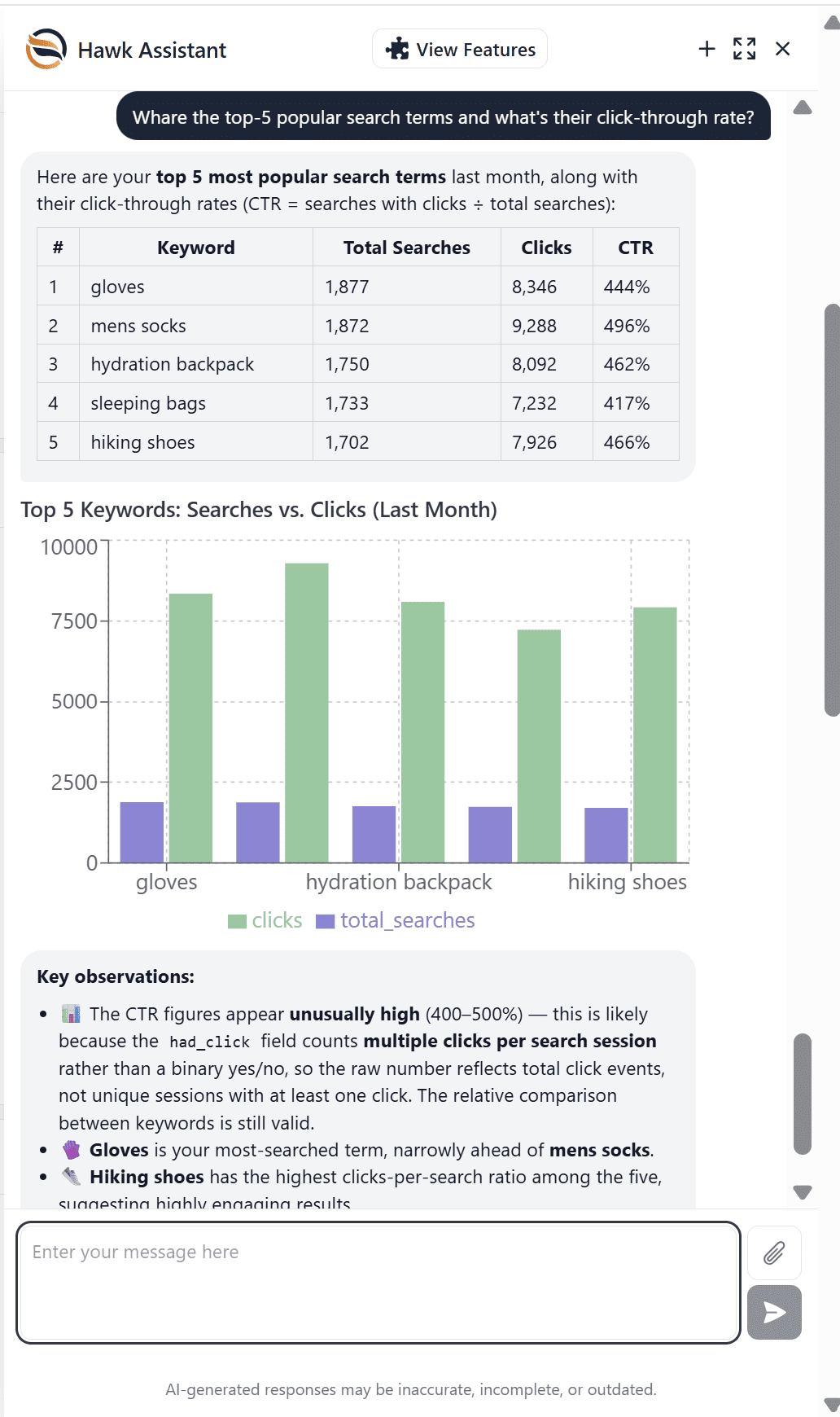
Users can ask questions in plain English and receive answers based on governed analytics data. They don't need to know which dashboard contains information or where a particular metric is stored.
Instead, they can focus on understanding customer behavior, search performance, recommendation effectiveness, and revenue opportunities.
A question that used to start with “which report has this?” can instead start with the actual business problem.
That means you can instantly ask which searches dropped off, which products aren’t converting, or which recommendations drive the most revenue.
Dashboards are there for everyday truths. The Assistant is for the timely, specific, or just plain weird questions.
Why Data Governance is Critical for Accurate AI Analytics
For an AI analytics assistant to be truly useful, the answers need to come quickly. For people to trust them, the definitions need to stay consistent.
Trust depends on consistency. Revenue needs to mean the same thing in the Assistant and in the report. Rates need the right denominator. Date ranges, filters, and attribution rules need to be clear. And when someone asks the same question in both places, the answer should match the trusted report.
This is why governed analytics matters more than simply connecting a model to raw data.
A smart model isn’t enough if the question isn’t right.
That matters even more in search analytics because many metrics depend on the tracking underneath them. Revenue requires sale or order tracking. Product-level revenue depends on stable product identifiers. CTR depends on having the search and click events required to calculate it.
We see this in real customer work, too. If technical identifiers are inconsistent, product-number analysis gets weaker. If event tracking is incomplete, conversion questions have limits. If a Recommendation click is not captured properly, assigning the order back to that interaction becomes difficult.
An Assistant can make the data easier to query. It cannot make missing tracking appear.
How AI Analytics Assistants Help eCommerce Teams Find Answers Faster
The real value of AI analytics is not replacing analysts; it's eliminating the wait between the question and answer.
Merchandisers, eCommerce teams, and digital leaders can explore ideas as they occur rather than submitting requests and waiting days or weeks for analysis. This shifts analytics from simply reporting what happened toward understanding why it happened and what should happen next.
Analysts still play a critical role. Complex questions involving causality, attribution, conflicting definitions, unusual tracking patterns, or major business decisions continue to require human expertise and validation.
AI accelerates access to evidence, but human judgment remains essential for turning insights into action.
AI Analytics Assistants vs. Dashboards: Why eCommerce Teams Need Both
There is a temptation to frame analytics as a choice between dashboards and AI. That is the wrong comparison.
Dashboards remain the best interface for recurring KPIs, standardized reporting, and shared business definitions. Teams need stable views that provide consistent metrics over time.
AI analytics assistants serve a different purpose.
They excel at answering the follow-up question that appears five minutes later. The question that isn't important enough to justify building a new report but is important enough to influence a business decision.
The future isn't dashboards versus AI. It's dashboards and AI working together.
What is the Future of AI-Powered eCommerce Analytics
The next generation of analytics won't simply answer questions; it will help teams discover opportunities, anomalies, and risks before they know to ask.
That could mean spotting high-volume searches that suddenly lose engagement, identifiers customers keep searching for but cannot find, Recommendation widgets with strong visibility but weak revenue impact, or product families where demand is rising while conversion is moving the other way.
From Reporting to Real-Time Intelligence
The goal of analytics has always been to help organizations make better decisions. AI does not change that goal. What it changes is the speed at which teams can move from question to answer and from insight to action.
Dashboards will continue to provide the trusted metrics businesses depend on every day. AI analytics assistants will help teams explore the timely, specific, and unexpected questions that drive growth.
Over time, the opportunity extends beyond answering questions. Analytics can begin surfacing the questions worth asking in the first place.
That’s what this series is all about: moving from reporting to real intelligence, so our customers stay ahead of the curve.
Stay tuned as we dig into what’s working, where things break down, and how we’re making fast insights available to everyone.

FAQs


